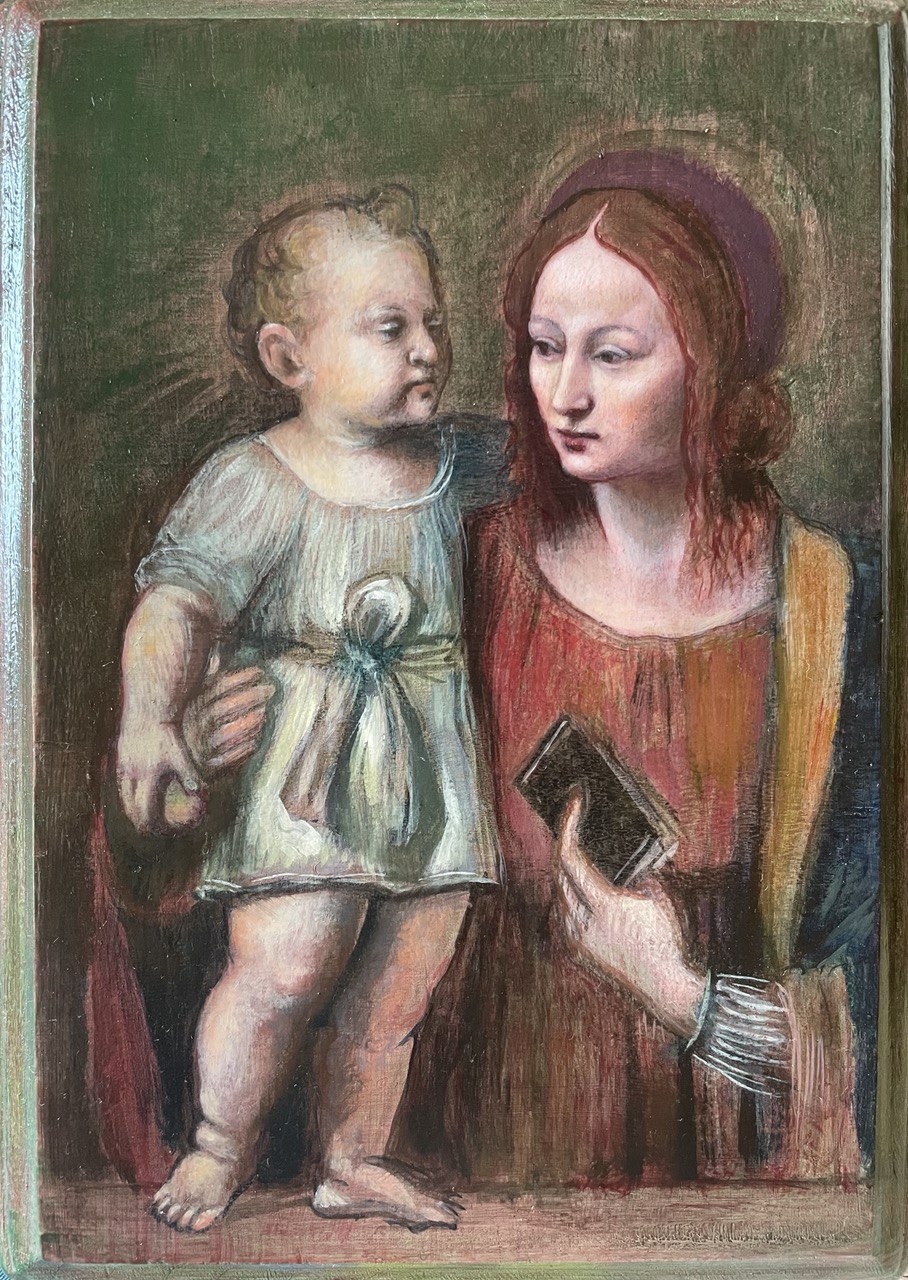
When I was in graduate school at the Pennsylvania Academy, a cheeky philosophy student from Temple University said to me: “Art is great and everything, but it won’t save your soul.” Well, I believed him at the time, but I beg to differ now.

In his papal Letter to Artists, the late St. John Paul II observes:
In shaping a masterpiece, the artist not only summons his work into being, but also in some way reveals his own personality by means of it. For him art offers both a new dimension and an exceptional mode of expression for his spiritual growth.
This connection between art and spiritual growth has always been present in my life’s work. As a kid, I knew very well that my art making was a religious act. I was always looking for God in my drawings and paintings. This manifested in several ways.
For one thing, I lavished myself with any and all picture book images of figurative art I could find. In glossy books and magazines, and too-fleeting TV documentary images, I devoured ‘Pietas’, ‘Crucifixions’, ‘Madonna and Childs’ and ‘Weeping Magdalens’ every chance I got. By middle school, I was filling my juvenile sketch books with as many ‘Man of Sorrows’ as I did vampires and princesses.
Yet, I was not only trying to represent God and his saints, I was also trying to please Him. I’m sure this sensibility had something to do with my upbringing. My parents’ presentation of religion was very relaxed and somewhat confusing. My dad inhabited the ambiguous status of the divorced and illicitly-remarried Catholic, and my mom was adrift for 40 years in the desert of ‘the occasional Protestant visitor.’ Yet they both played a part in linking art and devotion in my young mind.
In spite of never venturing to speak about religion overtly, my mom gave me the feeling that doing artwork is a special activity. She always treated my drawings with a marked reverence. Judging from her demeanor, it seemed like making art was the most honorable thing I could do for her. My dad was less than an art-lover, but I thank him for telling me that it would be okay for me to draw during Church—so long as I draw pictures of angels!
I remember how my parents spontaneously sent me forth in the middle of Holy Mass at four years old, to give my artwork to God. After communion, during the customary interlude for meditation, they suddenly ejected me from our pew. A bit bewildered, I proceeded alone down the center aisle with my drawing held out before me in fear and trembling, reverently handing over my picture to the kindly priest, seated in his chair.
A Protestant might call this my first “altar call.” In the Catholic liturgical sense, it was a “bringing forth of the gifts.” Out of order as it was, I believe the idea was well intentioned. It might have been my first act of faith. I remember having a parallel experience walking down the aisle to present myself for Holy Marriage. Certainly, the liturgical image has stayed with me. The more I mature in my Catholic faith, the more grateful I am for it.
These few overt acts of religion I associated with my artwork formed me and had a good effect on my soul. But later on, as I moved away from the faith of my childhood and began to experiment, wandering into forbidden territory, even into debauchery and addiction, art remained the one activity in my life that kept me ‘strait.’
Art demands sobriety, discernment—honesty. With all my heart, I wanted to draw and paint well. I wanted to show things in the world as they really appear—and I wanted these things to impart depth and beauty. Nothing puts things into proper perspective like trying to draw from life. An overall lack of attentiveness to Reality is a slap in the face in the form of mediocre work. It’s obvious.
On the other hand, success in executing a work of art rewards judgement, knowledge, patience, wisdom, etc. When art ceases to be purely self-indulgent, it becomes an exercise in the virtues. This is what I learned in college along with the principles of form and color theory. Art became the invisible ‘rule and guide’ of my Guardian Angel. It goaded, prodded and gradually led me to better things.
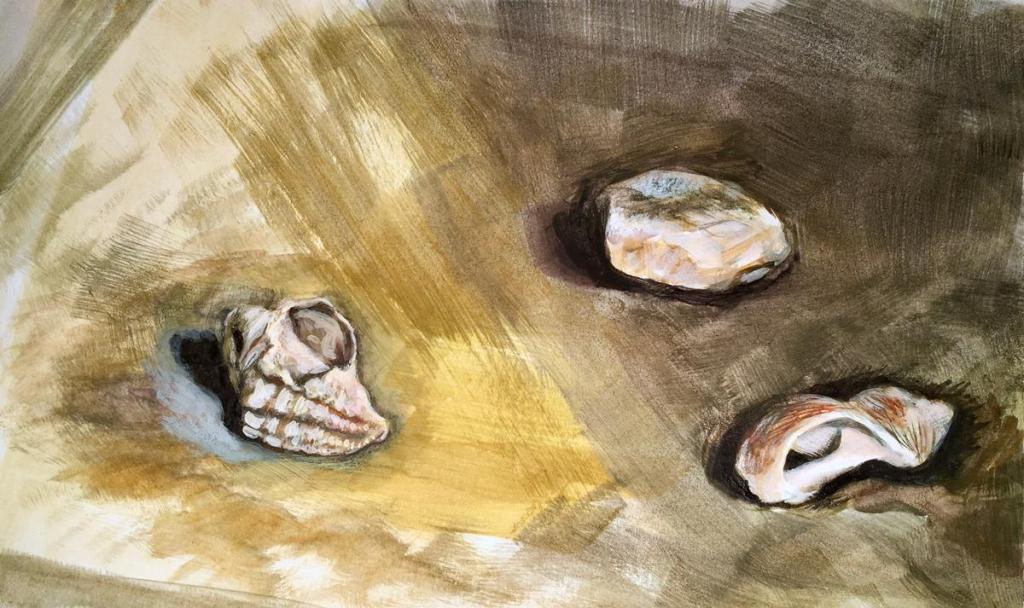
In a nutshell, what began as a quest for artistic virtue ended up in the gradual transformation of my life. I found out through experience that I can’t paint worth a damn when I’m drunk. Later, I found out the key to living a beautiful life was to let my Creator guide me in shaping this life according to His image; the original image planted deep within my heart.
The ‘poet-Pope’ continues:
Not all are called to be artists in the specific sense of the term. Yet, as Genesis has it, all men and women are entrusted with the task of crafting their own life: in a certain sense, they are to make of it a work of art, a masterpiece.
So can art save your soul? God continues to reach mine through art. Not only through holy images that keep my inner eye tuned to His Reality, but through this life. The life of an artist—a daughter, wife and mother—this is what I’ve been given to shape into something worthy. It’s just a little sacrifice, all I have, my own self, to offer back to Him.
 Michael Shelby Suberlak
Leave a comment