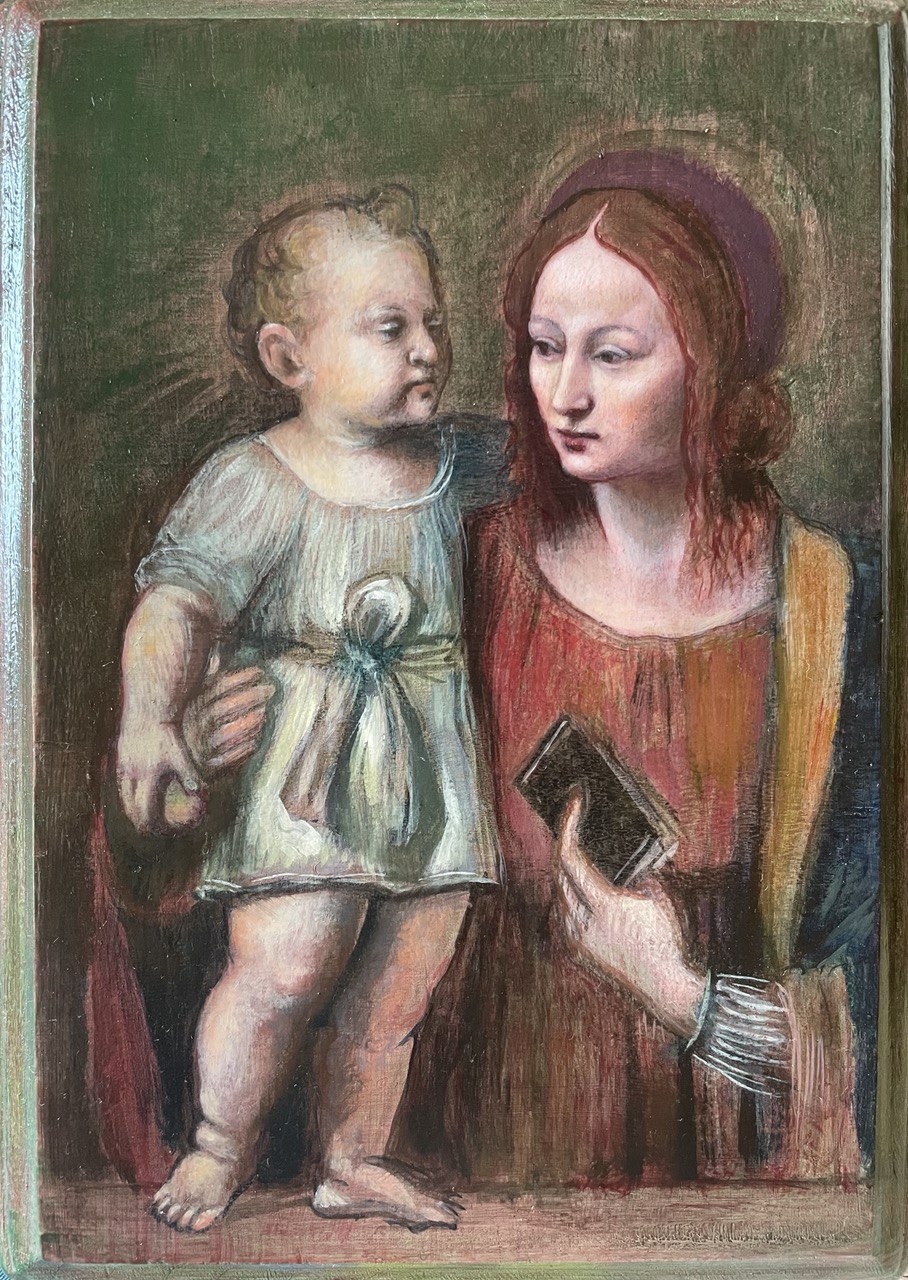

It’s easy to look back with sighs of regret, as a mother “in the weeds,” as a person in midlife, having made life’s commitment at last, at the unfinished work; work that has been eclipsed by the demands of your dependents, and cannot be attended to again for some months or years, if ever. What can you do, but accept the circumstances of your state?
So much of motherhood is learning exactly what your limitations are. So much of adulthood is realizing what is possible and leaving aside the rest for another day—or another decade. You are no longer living in airy dreams of the future, imaging what might be. You are grappling with the daily reality of what is, and what you have to do right now—because this, here, is the most significant work of your life.
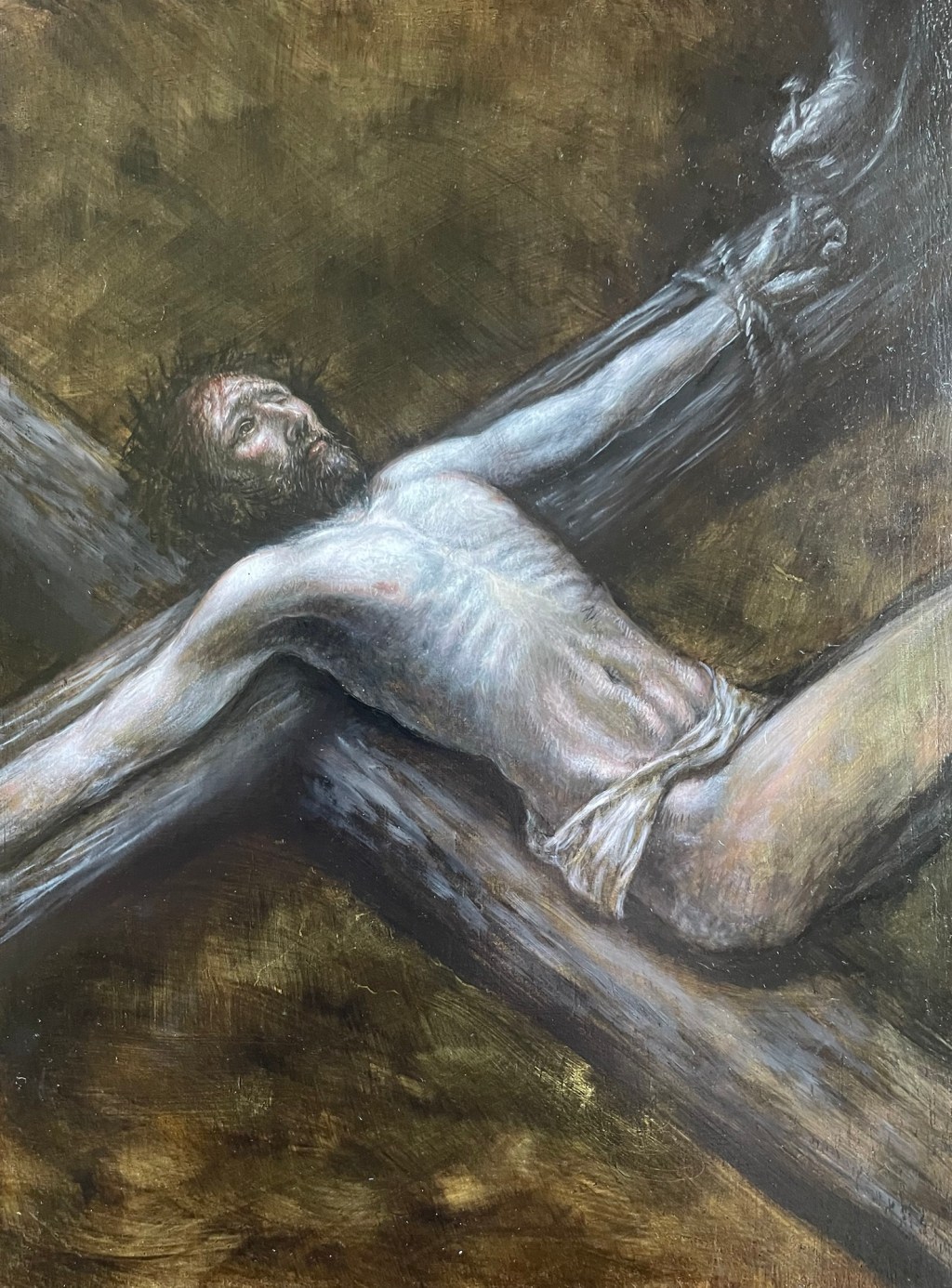
In 2016, I was commissioned by a client to make a series of 15 paintings: The 14 Stations of the Cross, plus a panel representing The Resurrection of Christ. “The Stations” or “Way of the Cross” is a Christian devotion that has been practiced for centuries. It usually consists of a series of vignettes of Jesus during the final hours of his suffering and death by execution. In Roman Catholicism, The Stations begin with Jesus being condemned to death by Pontius Pilate, and end with his burial. Usually these scenes are depicted on small panels that serve as markers or “stations” along a pathway, often inside of a sanctuary and sometimes outdoors. Pilgrims therefore can walk from station to station on the Way of the Cross in solemn meditation on these events. The addition of a panel to represent the Resurrection of Christ is a variation on the traditional 14 Stations, and this was something the client wanted.
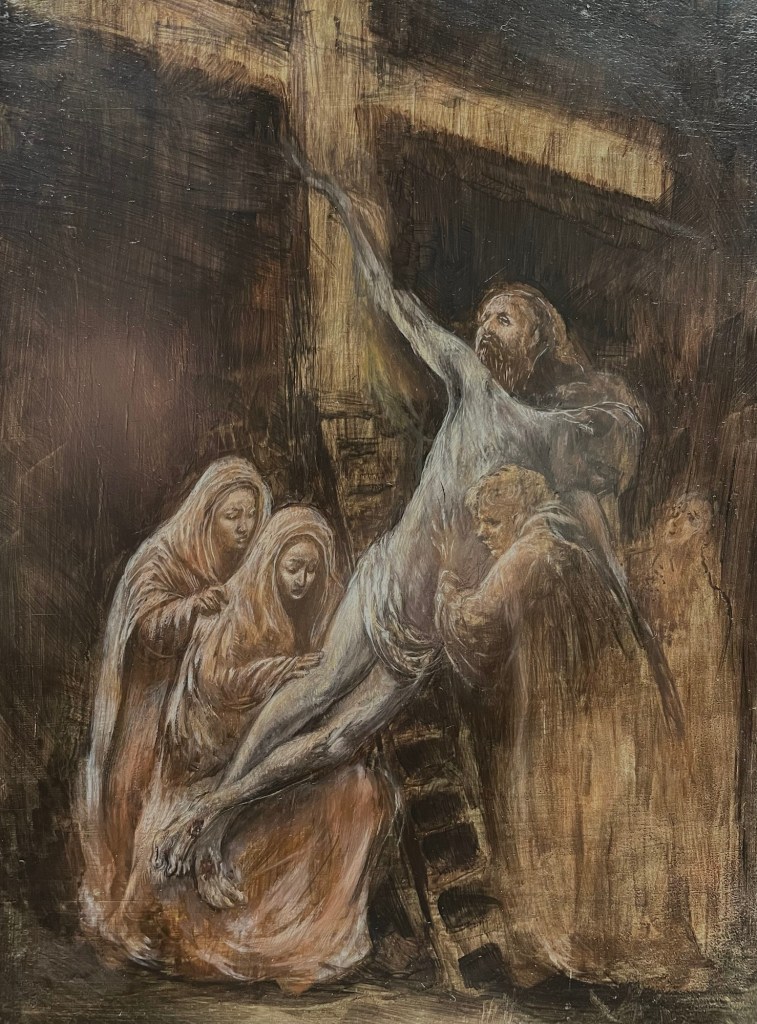
The contract we drew up gave me two years to complete it. I had no inkling that it would take me even that long. Now, eight years later and counting, The Stations still are not quite finished. They are hung around, unframed, on my walls, to keep them away from my children’s destructive little hands, and as a constant reminder of the work I have yet to complete for my client—who assures me that he has no problem waiting.
The whole situation has been rather embarrassing and humbling to me. Never once in my life have I been late in completing a commission. But then, I have never before gotten married in the middle of a project, and then become pregnant, and then given birth to children, four living and two miscarried, in rapid succession.
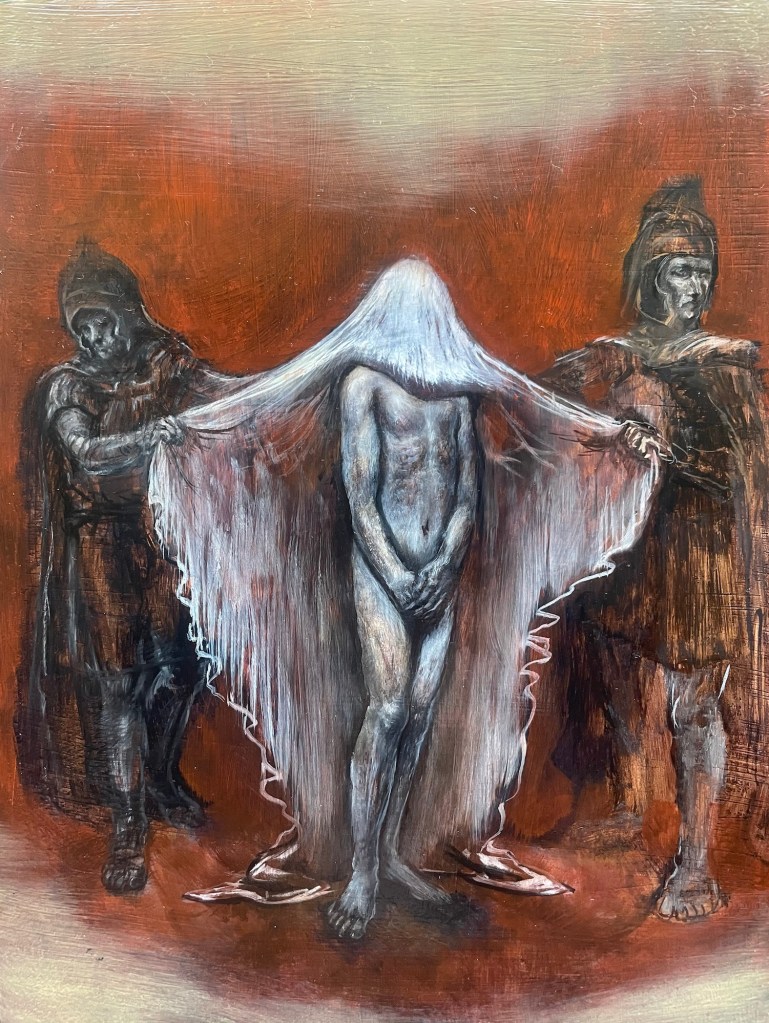
The remuneration, already paid years ago, is of course no longer a part of the discussion. My client, now a long time friend, has become a kind of “uncle” to my children, and the Stations still hang there along my walls like some kind of Holy Albatross.
The fact that these deeply troublesome paintings happen to depict our Lord in his suffering is poignant to me. Years ago, I began this project valiantly, in a refreshing air of pure inspiration. I was an unmarried lady in my mid 30s. Now in my 40s, married with four young children and dealing with almost constant exhaustion and health challenges, the project has taken on a different quality. Over time, these paintings have become a personal symbol of my own weakness. They are an analog to the difficult march of these past several years.
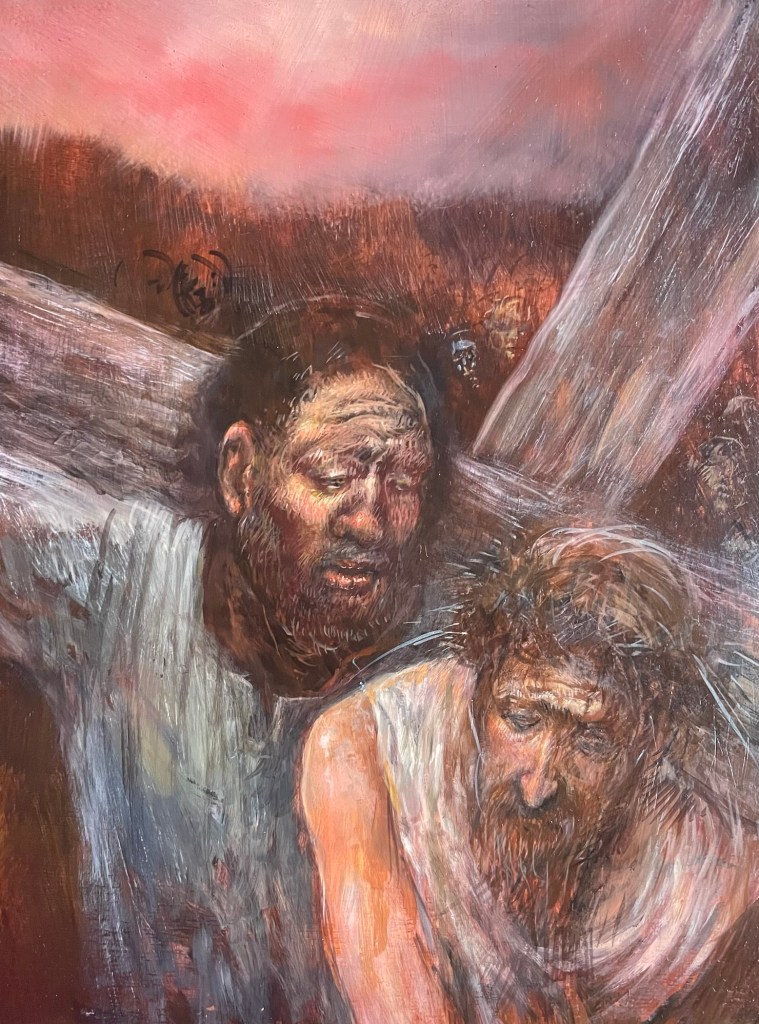
The panel that depicts Simon of Cyrene helping Jesus to carry his cross is particularly meaningful, since it is an emblem of true friendship. The man who commissioned these from me, has not ceased to carry this burden in a special way with me, through his patience and generous spirit.
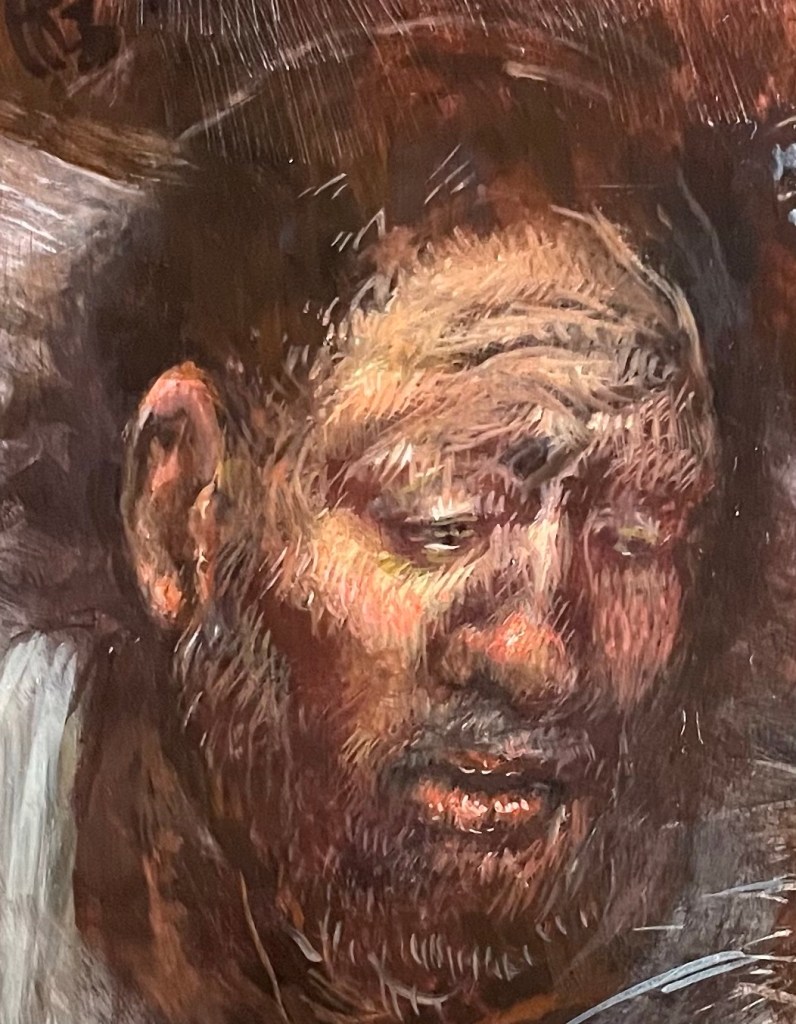
There is very little left to do, and yet I find it hard to imagine life after The Stations. They’ve been with me through my entire engagement and marriage, through pregnancies, moves and the births of my children, the dread pandemic experience, a traumatic birth complicated by Covid pneumonia, miscarriages, complicated pregnancies and more illnesses. The idea of actually finalizing and sending them off to their owner seems almost unreal to me.
Although there is a part of me that wants more than anything for them to be finished, to bring this story to an end, and send them off into the world, I’ve become puzzled as to how to think of them. They are not what I imagined they would be. We had talked originally about making them bright, and romantic and beautiful—in contrast with the deathly subject matter. I had planned for them a pallet of flesh tones dominated by rose. I wanted these paintings to visually re-frame the sufferings of Christ with the assurance of the spiritual goodness and beauty of his sacrifice.
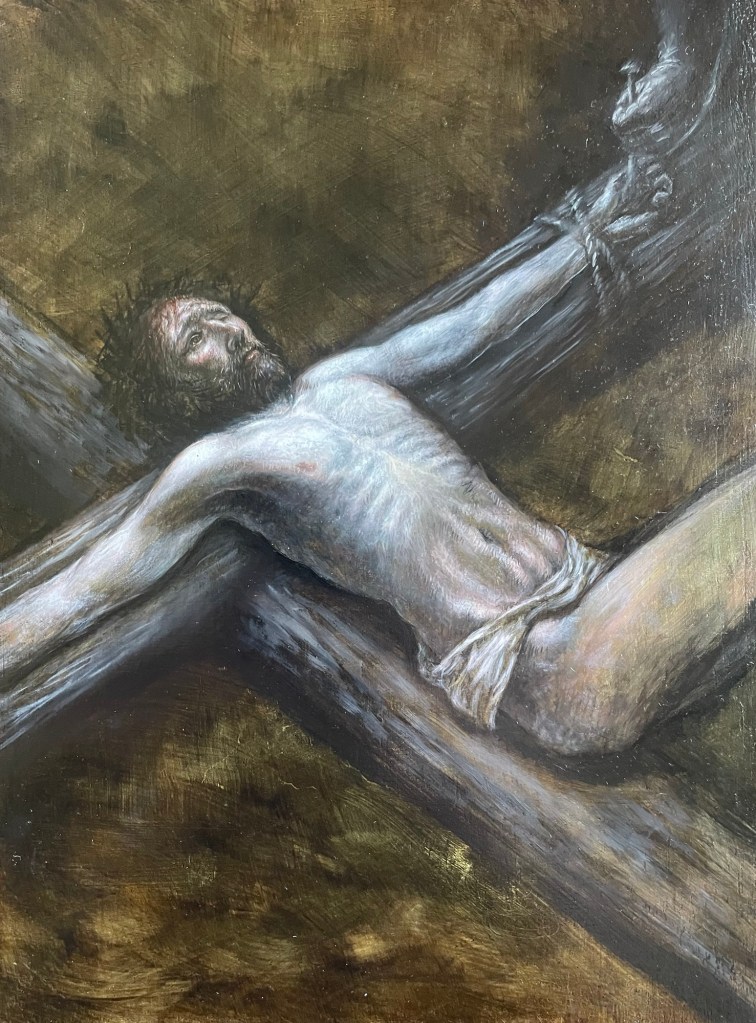
But that’s not what came. They are much darker—in color, and certainly in feeling, than I ever anticipated. Sometimes I see them as “black and horrid”, the kind of thing Alberti, in his famous Treatise on Painting, admonished his students not to do. Sometimes, I see them as “morbid reflections” and nothing to be proud of. I feel convicted by them. At other times, they represent an impenetrable fog of uncertainty. I can’t remember how to paint them.

My Stations have slowly, quietly become a metaphor for the most difficult things in life. They have been dabbed and blotted and scraped upon all through these years of transition from the bright, public, effervescent life of a working artist, to shadowy, hidden, bedroom-life of a parturient and post-partum mother—and not a young one.
Far be it from me to compare my blessed, relatively comfortable state to that of Our Lord trudging to his torturous death. That would be laughable. Yet, how else would I contextualize my own difficulties, if not in the Way of the Cross? This is what Holy Mother Church instructs us to do. Until we see our own sufferings reflected in the sign of Christ’s passion, how can we make use of the gift he is offering us with outstretched, bleeding hands? Fittingly, my own “passion” is as small and pathetic as these 6×8 inch painted panels; mere scratchings in the mud that vainly attempt to represent the most awesome, awful event the world has ever seen: the suffering and death of God. These years of painting the stations have been full of blessings; but these have come wrapped in a package of stretched, torn flesh; blood, toil, filth, sickness and pain; falling down and lifting up; death and love—love in its tenderest, most fearsome aspects.

And what else did I expect? That the way of the Cross would be pretty? I’m afraid to admit that I really thought I could make it that way; that I could make something humanly pleasing out of this subject matter. But I couldn’t. Or at least, I didn’t. It appears that this arduous time of maturation, the necessary trials of this vocation, have made my Stations exactly as they should be; exactly as they have to be. I can do nothing else.
And of course, they are just paintings. Just some silly little 6×8 inch birch wood panels. Perhaps the main thing that stands in my way of finishing them is the need to accept them as they are and must be. Just as we have to accept our lives; the crosses that have been entrusted to us. Can we carry them willingly, to the end? If we cannot suffer beautifully, according to our own expectations, can we at least accept our suffering, and our littleness, and get on with it?
We do have help.
 Michael Shelby Suberlak
Leave a comment